Learn how to make perfectly crispy on the outside, and soft and airy on the inside, Vietnamese baguettes at home. This banh mi recipe only needs 5 simple ingredients!
Learn how to make perfectly crispy on the outside, and soft and airy on the inside, Vietnamese baguettes at home. This banh mi recipe only needs 5 simple ingredients!
This Post May Contain Affiliate Links. Please Read Our Disclosure Policy.
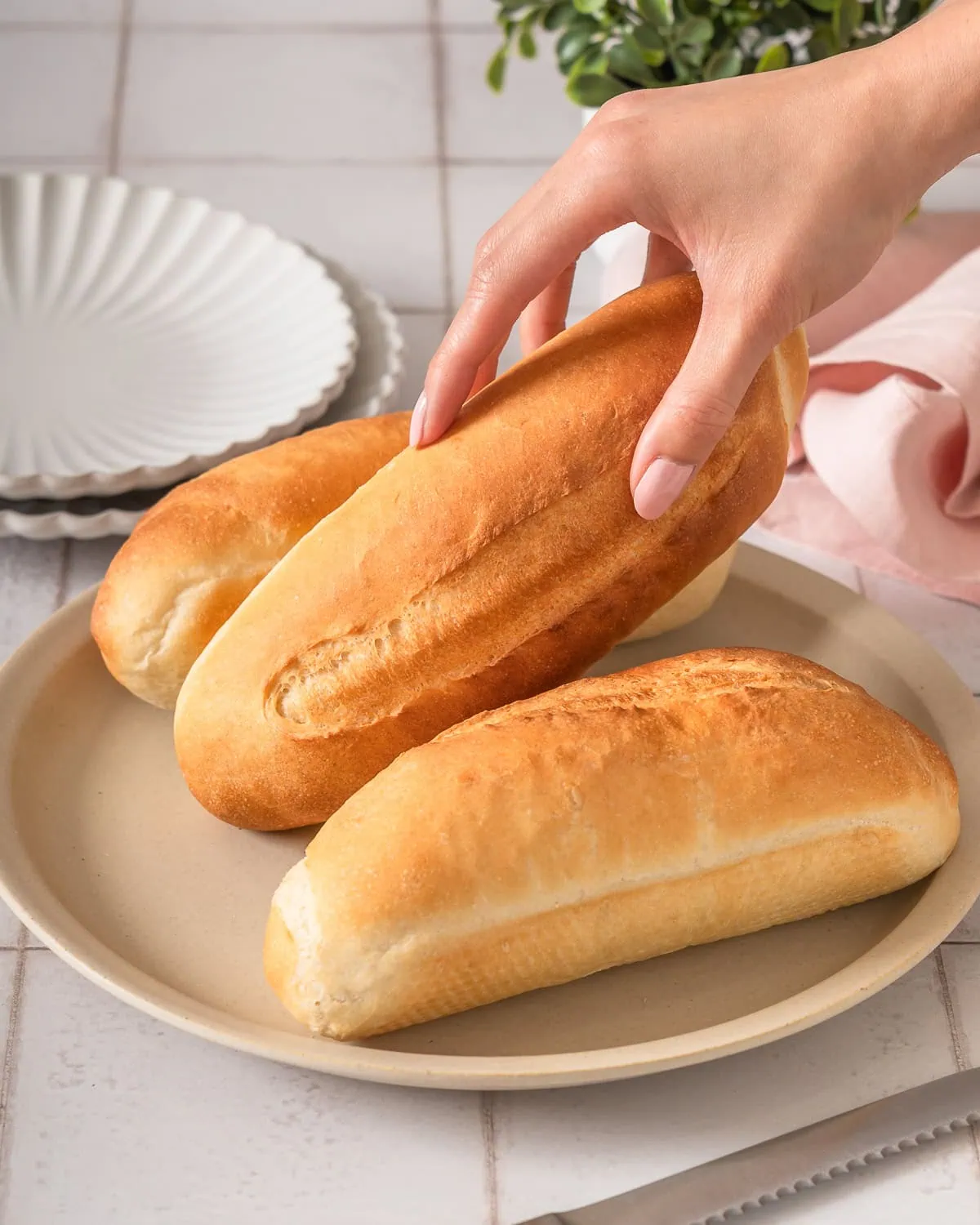
The Vietnamese baguette, aka banh mi, is an iconic bread in Vietnamese cuisine. It has a perfectly crisp, crackly exterior and a delicately airy and soft interior. This bread recipe has been tested multiple times, and I think I have found the perfect Vietnamese bakery-style ratio that uses only 5 simple pantry ingredients, with no added bread improver.
Banh mi bread is so incredibly versatile! It can be used with just butter and honey for sandwiches, as a dip for warm, comforting stews, or as a base for my favorite Vietnamese shrimp toast appetizer.
Vietnamese baguette, also known as banh mi, is a Vietnamese take on a French baguette. These Vietnamese bread rolls originated during the French colonial period in Vietnam. It is made with bread flour, yeast, salt, and water. They have a thin, crispy crust and a soft, airy interior.
You can find all the ingredients for this Vietnamese baguette recipe at your local grocery market. Full measurements and links to everything I used are in the recipe card below.
Warm Water: needs to be warm at 105-110°F (40-43°C). This will help activate the yeast.
Instant Yeast: is the main fermenting and rising agent. It is what creates the air pockets and expands the banh mi bread dough.
Sugar: adds a subtle sweetness, is key for the browning crust, and also aids the yeast in fermenting.
Bread Flour: forms the structure of the dough.
Salt: strengthens the gluten and controls the yeast. It also enhances the overall flavor of the banh mi baguette.
Unsalted Butter: adds another layer of fat in the bread, which creates a softer and more tender crumb.
Substitutions and Additions
Rice Flour: you can replace 50 g of bread flour with rice flour for a lighter crumb and thinner crust.
Active dry yeast: will need about 7 grams instead and 10 minutes to activate.
How to Make
Here are the step-by-step instructions for how to make this Vietnamese baguette recipe.
Mix 105-110°F water with sugar in a measuring cup until the sugar dissolves. Then add the instant yeast. Mix and set aside for 5 minutes.
In a stand mixer, add the bread flour and salt and mix until combined. Next, add the yeast mixture and melt the butter. Mix on low speed until combined. Then increase to medium speed until the dough is smooth, elastic, and tacky, about 8-10 minutes.
Lightly grease a large bowl with oil. Transfer the dough, cover with plastic wrap, and proof in a warm place for 45 minutes to 1 hour, or until it is 1.5x its size.
Divide the dough into 6 equal pieces, then roll each into a ball. Cover the dough with plastic wrap or a damp towel as you roll out each ball. Gently flatten each dough into a rectangle. Roll down and pinch the edges. Pinch the seams to seal.
Place the dough seam side down on a bread baking tray, about a few inches apart, to proof. Lightly cover with plastic wrap and proof in a warm place, such as the oven, for 30 minutes, or until 1.5x in size.
Preheat the oven to 450°F. Place the wire rack in the center of the oven. Pour boiling water into a large baking pan on the bottom rack.
Once the dough is proofed, spray the baguettes with water. Then score each loaf lengthwise. Bake for 16-18 minutes until golden brown. Remove the water pan after 7 minutes.
Cool the banh mi bread for 15 minutes on a wire rack before slicing and serving. Enjoy!
Expert Tips
Use a kitchen scale. Measuring cups and spoons can yield skewed ratios. For the most accurate measurements, use a kitchen scale.
Signs the dough is ready to proof. The dough should be smooth, elastic, and slightly tacky. It should pull away from the sides of the bowl. Stretch a small piece of dough until it is thin without tearing; it is done.
Do not overproof. The first and second proofs should just reach about 1.5-2x the original size. When rolled, they should be puffy yet retain their original structure.
Gently shape. Gently shape the dough into rolls without completely deflating it.
Spray the dough before baking. This will create the signature, ultra-thin crust of banh mi bread.
Steam is important. Steam the banh mi baguette for the first 5-7 minutes of the bake.
Cool for 15 minutes. On a wire rack before serving.
Storage Instructions
This Vietnamese baguette is best served the same day it is baked. You can store any leftover bread in a paper bag in the refrigerator for up to 2 days.
Reheat: Bake the banh mi bread in a 350°F oven for 3-5 minutes, until crisp.
Freeze: Freeze the cooled-to-room-temperature bread in a freezer-safe, air-tight bag for up to 2 months. Bake directly from frozen for 8-10 minutes or until crisp.
Pairing Suggestions
Vietnamese baguettes can be served as a sandwich, used for a dip, or used as a base for an appetizer.
What makes the Vietnamese baguette different from the French ones?
This recipe differs from French baguettes in that it yields thinner, crispier crusts and a lighter, airier crumb. It is meant for Vietnamese banh mi sandwiches, which have enough structure to be light and crispy yet still incredibly soft on the inside for the perfect bite.
How do I get my banh mi bread crust crispy?
The signature crispiness comes from high heat with steam during the baking process. The steam helps the dough expand quickly, creating a thin, crackly crust with a soft, airy interior.
Why is my banh mi bread dense?
This could be because the dough is 1) not hydrated enough, 2) the dough was overly flattened during shaping, 3) the oven was not hot enough, or 4) there was not enough steam in the oven.
Activate the yeast. Mix 105-110°F (40-43°C) water and sugar in a measuring cup until the sugar dissolves. Then add the instant yeast, mix, and set aside for 5 minutes. (10 minutes if using active dry yeast)
Prepare the dough. In a stand mixer, add the bread flour and salt and mix until combined. Next, add the yeast mixture and melted unsalted butter. Mix on low speed for 1-2 minutes until combined. Then increase to medium speed until the dough is smooth, elastic, and tacky, and it pulls away from the sides after about 8-10 minutes.
Proof the dough. Lightly grease a large bowl with oil. Transfer the dough, cover with plastic wrap, and proof in a warm place for 45 minutes to 1 hour, or until it is 1.5x to doubles in size.
Divide and shape. Divide the dough into 6 equal pieces, then roll each into a ball. Cover the dough with plastic wrap or a damp towel as you roll out each ball. If the dough is sticky, sprinkle bread flour on your workstation and on your rolling pin. Gently flatten each dough into a rectangle without completely deflating the dough. Starting from the top, roll down tightly and pinch the edges as you move downward. Pinch the seams to seal, then roll a few times to smooth them out.
Proof. Place the dough seam side down in a baguette pan, about a few inches apart, to proof. Lightly cover with plastic wrap and proof in a warm place for about 30 minutes, or until it is 1.5x its size. It should be puffy and hold its shape.
Prepare the oven. Preheat the oven to 450°F (232°C). Place the wire rack in the center of the oven. Pour boiling water into a large baking pan on the bottom rack.
Score and bake. Once the dough is proofed, spray the baguettes with water. Then score each loaf at a 45-degree angle lengthwise about 1/8 inch deep. Place in the oven and bake for 16-18 minutes until golden brown. Remove the water pan after 7 minutes.
Cool and serve. Cool the banh mi baguette for 15 minutes on a wire rack, then slice and serve. Enjoy!







Rate & Review What did you think of this recipe?