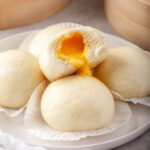
Steamed Egg Custard Buns (Liu Sha Bao)
These irresistible dim sum classic steamed molten egg custard buns, or liu sha bao, are an instant crowd pleaser. It is impossible to say no to these pillowy soft steamed buns bursting with buttery sweet and salty egg custard.
Servings 15 buns
Calories 490kcal
Ingredients
Egg Custard
- 4 salted egg yolks
- 6 tablespoons 80 g unsalted butter, room temperature
- ¾ cup 70 g powdered sugar
- 4 tablespoons 50 g evaporated milk
- 3 tablespoons 35 g milk powder
- 2 ½ tablespoons 30 g custard powder
Bao Bun Dough
- ¾ cup (180 ml) whole milk, 110 F-115 F
- 1 ½ teaspoons (6 g) instant or active dry yeast
- 1 tablespoon (15 g) granulated sugar
- 2 cups + 1 tablespoon (300 g) all-purpose flour
- ¾ cup (100 g) wheat starch
- ½ cup + 1 1/2 tablespoon (70 g) powdered sugar
- 1 teaspoon (5g) baking powder
- ¼ teaspoon (1 g) salt
- 1 tablespoon (15 g) vegetable shortening
- 1 large (30-35 g) egg white
- 1 tablespoon (15g) vegetable oil
- 1 teaspoon (5g) lemon juice or lime juice
- ¼ teaspoon (1 g) baking ammonium carbonate
Instructions
Make the Custard Filling
- Prepare the salted egg yolks. Separate the egg yolks from the egg whites. Rinse the egg yolks in a bowl of water and drain. Place the egg yolks on a small plate in your steamer and steam on medium-high for 10 minutes.
- Mix the butter and powdered sugar. While the egg yolks are steaming, whisk the softened butter and powdered sugar until creamy.
- Add in the rest of the ingredients. Add the evaporated milk, milk powder, and custard powder and mix until incorporated.
- Smash the steamed egg yolks and fold them into the mixture. Once the egg yolks are done, smash the egg yolks into small pieces with a fork. Using a spatula, gently fold in the mashed egg yolks.
- Chill the mixture then form into balls. Place the custard mixture in the freezer for about 1 hour or the refrigerator for 3 hours or until the mixture has hardened. After the mixture has hardened, take the mixture out and form 1 inch balls on a parchment-lined baking tray or large plates. Place back in the freezer until the dough is ready.
Make the Bao Dough
- Prepare the yeast. Warm the milk to 110F degrees. Add the active dry yeast and granulated sugar. Cover with plastic wrap and let sit for 10 min.
- Sift the dry ingredients. Sift flour, wheat starch, powdered sugar, baking powder, and salt into the bowl of your stand mixer with a paddle attachment. Mix together on low.
- Add in the shortening. While the mixer is mixing on low, add in the shortening. Make sure the shortening is broken up into small pieces by feeling it with your hand.
- Activate the ammonium carbonate with lemon juice. In a separate small bowl, combine lemon juice with baking ammonium carbonate. Let it fizzle for 5 min.
- Liquify the egg white in oil. In another small bowl, combine the room temperature egg white with vegetable oil. Liquify the egg by pulling up the egg white with a fork a few times.
- Mix all the mixtures together. In the stand mixer on low with the paddle, mix the yeast milk mixture, then add the egg and oil mix, then lastly add the ammonia and lemon beat for 30 seconds.
- Switch to a dough hook and knead the dough. After 30 seconds, switch out for the dough hook and mix on level 2 speed for 2-4 minutes or until it forms into a ball in the mixer and is no longer sticking to the bowl. The dough should be tacky but not overly sticky. Take the dough out and gently knead the dough by hand for 1 minute. Form the dough into a ball and transfer it into a lightly greased large bowl.
- Proof the dough. Cover with plastic wrap and place in a warm area (100F) for about 1-1.5 hours or until double in size
- Divide and roll out the dough. Divide into 15 equal pieces and roll into smooth balls. Then, using a rolling pin and roll out dough into 4- inch discs. Make sure you roll the edges thinner than the center.
- Add the filling and form the bun. Add 1 tablespoon of filling and wrap the dough around the filling to form a ball. Then pinch to seal. You may need to remove the excess dough at the end.
- Let the buns rest. Place parchment squares or cupcake liners underneath and let buns rest for 15 minutes
- Steam the buns. Wrap the lid of your steamer with a dish cloth to prevent the condensation from falling into your steamer. Add water to your steamer and bring the water to a boil. Place the buns 2 inches apart of your steamer, cover and steam on medium heat for 10-12 minutes. After steaming, turn off the heat and leave the buns to sit in the steamer for 1 minute to prevent them from wrinkling from the temperature shock. You will have to steam the buns in 2-3 batches depending on the size of your steamer. Cover the uncooked buns with plastic wrap and place them in the refrigerator to slow down the yeast activity until they are ready to be steamed.
- Serve immediately when hot.
Notes
- Use fresh salted eggs from the Asian grocery store for best-tasting results. If they are not available, then the vacuumed sealed salted egg yolks work as well.
- Cream the butter with the sugar before adding the other ingredients in. This is really important for that silky custard. Creaming the butter ahead of time will de-clump the mixture and form that creamy finish.
- Freeze the custard. Freezing the custard will firm the custard up making it easy to form into balls. After you form them into balls immediately place them back in the freezer so they hold their shape.
- Use a kitchen scale! Using a scale will always give you the best results guaranteed.
- Use a stand mixer. This will help you knead the dough faster. You can also knead this by hand but it will take about double the time.
Tips for the Bao Dough
- If the dough is too sticky, add 1 tablespoon of flour at a time until it becomes tacky and doesn't stick to the bowl.
- If the dough is too dry, add 1 tablespoon of warm water at a time until it reaches the tacky consistency. You don't want the dough to be too dry, the seam will not properly seal when you pinch if it is and the filling will ooze out during the steaming process.
- Only roll out the edges of the dough when making the dough discs. We want the dough to be evenly distributed throughout and that means having thinner edges to pinch and a thicker fluffy center.
- Tightly pinch the dough together. Don't be afraid to really seal it together.
- Make sure to rest the bao for 15 minutes after shaping. This is crucial for that slight rise and fluffiness in the bao. Careful not to wait too long because the yeast will overrise and create a gap between the dough and the filling
- Steam the dough over medium heat. If the steam is too hot there may be a chance that the filling will explode and burst out.
- If your bao is wrinkly after steaming, it probably means that either your steam was too hot or you steamed them for too long.
- The custard buns taste best when they are immediately served from the steamer. That is when you get that gooey gold. But you can also serve them at room temperature as well but keep in mind the custard will coagulate and will no longer be runny.
Nutrition
Serving: 1g | Calories: 490kcal | Carbohydrates: 40g | Protein: 17g | Fat: 29g | Saturated Fat: 14g | Polyunsaturated Fat: 12g | Trans Fat: 1g | Cholesterol: 243mg | Sodium: 2218mg | Fiber: 1g | Sugar: 9g